コンテンツに進む

Power Banks Grounded, Qi2 Takes Off: The 2026 Business Travel Charging Playbook

Executive Summary

The regulatory and technical environment for travel charging changed on two fronts simultaneously. Airlines tightened lithium-battery handling in the cabin, while the Qi2 25W standard made short-dwell wireless charging genuinely fast. This playbook reconciles both into a compliant, practical kit.

  • Multiple carriers — beginning with Singapore Airlines and its low-cost subsidiary from 1 April 2025, followed by Malaysia Airlines and Cathay Pacific — prohibit using power banks to charge devices in flight and charging power banks from onboard USB ports.
  • Capacity thresholds are now enforced in practice: units between 100Wh and 160Wh (roughly 20,000–32,000mAh) require prior airline approval; above that they are generally refused.
  • Qi2 25W restores a fully depleted phone to about 50% in 30 minutes — which maps directly onto a gate wait or a lounge stop.
  • Qi2 charging is entering the cabin itself: a WPC member launched a Qi2 wireless charging module for commercial aircraft in April 2026.
  • Long-run context: Boeing's 2026 Commercial Market Outlook projects air travel demand roughly doubling over twenty years, with the global fleet growing nearly 80% to over 50,000 aircraft by 2045 — cabin power demand scales with it.
01
Introduction

The 2026 Travel Power Reset

For most of the last decade the business travel charging answer was a single object: a large power bank. It was capacity-dense, airline-agnostic and required no infrastructure. That answer has been progressively withdrawn.

Woman reading in airport lounge with luggage and Elecdov Qi2 magnetic wireless charging station
Gate-side and lounge dwell time is where the modern travel charge is actually recovered.

Following a rise in cabin battery incidents, Singapore Airlines announced in March 2025 that from 1 April 2025 passengers — across the SIA Group including Scoot — would no longer be permitted to charge power banks via onboard USB ports, or to use power banks to charge personal devices, for the duration of the flight. Malaysia Airlines introduced a comparable restriction in the same period, and Cathay Pacific subsequently joined. Through 2026 the list has continued to expand rather than contract.

1 Apr 2025First major in-flight power bank ban
100–160WhRequires airline approval
~30 minQi2 25W to 50% charge
Apr 2026Qi2 cabin module launched

Meanwhile the technical side moved in the opposite direction. The Wireless Power Consortium's Qi2 25W standard delivers nearly 70% more power than the original Qi2 profile and reaches roughly 50% charge in half an hour. In April 2026 a WPC member company launched a Qi2 wireless charging module engineered specifically for commercial aircraft cabins. The infrastructure is moving toward the seat; the traveller's job is to carry the right receiver-side hardware and stop relying on a device class that airlines are actively restricting.

What this playbook covers

  • The regulatory map as it actually applies at the gate and in the cabin.
  • Why certification, not capacity, is now the gating criterion for travel charging hardware.
  • How to convert bounded dwell time — lounge, gate, taxi — into usable charge.
  • Multi-modal reality: rail and road segments where the rules differ again.
  • The hotel room as a temporary workstation.

Chapter Q&A

Q: Are power banks banned from flights entirely?
A: No. The restrictions concern use and recharging during flight, not carriage. Power banks must be in carry-on baggage, never checked, and most carriers now prohibit operating them in the cabin. Always check the specific operating carrier's current policy before departure.
Q: Why did airlines tighten these rules?
A: The stated driver is a rise in cabin fire and thermal-runaway incidents involving lithium cells. An unmonitored power bank charging in a seat pocket is difficult to reach quickly, which is precisely the scenario the restrictions target.
02
Regulation

The Rulebook: Capacity Thresholds, Certification and What Gets Refused

Travel charging compliance in 2026 rests on two separate tests. The first is a capacity test applied at check-in and at the gate. The second is a certification test that determines whether hardware behaves predictably once it is in use.

Elecdov factory production line with technicians performing quality control on wireless charging electronics
Certification is a laboratory process, not a printed claim — production-line quality control is where compliance is either real or nominal.

Capacity thresholds in practice

Rated capacity Approximate mAh Typical carriage rule In-flight use
Under 100Wh Up to ~20,000mAh Carry-on only, generally no approval needed Increasingly prohibited
100Wh – 160Wh ~20,000 – 32,000mAh Requires prior airline approval Prohibited on restricting carriers
Above 160Wh Above ~32,000mAh Generally refused for passenger carriage Not permitted
Wireless charging stand (no cell) N/A — no stored energy Unrestricted, carry-on or checked Permitted where a power source exists

The final row is the structurally important one. A magnetic wireless charging stand contains no energy storage cell. It is a transmitter, not a battery. It therefore sits entirely outside the lithium-battery regulatory framework that is tightening around power banks — which is why the centre of gravity of a compliant travel kit is shifting from stored capacity to efficient transfer at available power sources.

The certification test

For the hardware itself, the relevant marks are QI2 alongside FCC, CE and RoHS. The Qi2.2 revision imposes a surface temperature ceiling of 40°C under sustained 25W output, enforced through Wireless Power Consortium authorised laboratory testing followed by interoperability testing against a testbed of previously certified products. That two-stage process is why a certified unit's behaviour is predictable in an unfamiliar environment — a hotel socket, a lounge table, an unfamiliar PD supply.

Elecdov Engineer's Note

A recurring traveller error is treating the wall adapter as interchangeable. A Qi2 25W stand negotiates its output profile from the upstream supply. Paired with an underspecified adapter it will silently operate at a lower profile — no error, no warning, simply a slower curve. When packing, treat the PD supply as part of the charger, not as a generic accessory, and verify it meets the stand's stated input.

Second recurring error: relying on public USB ports. These are an established data-exposure vector. Magnetic wireless transfer carries no data path, so charging from an untrusted socket through your own certified stand removes that exposure class.

Chapter Q&A

Q: Can I pack a wireless charging stand in checked baggage?
A: Yes. A stand with no internal cell is not subject to lithium-battery carriage restrictions. That said, it is small and flat enough to keep in the cabin, where it is actually useful during the journey.
Q: Do I still need a power bank at all?
A: For most itineraries with lounge, gate and hotel access, no — a Qi2 25W stand plus a PD supply covers it. For field work or long ground segments without sockets, carry one under 100Wh, keep it in carry-on, and do not operate it in the cabin.
03
Technology

Why Qi2 25W Fits the Shape of Travel Time

Travel does not provide continuous charging windows. It provides a series of bounded intervals: a 40-minute lounge stop, a 25-minute gate wait, a 20-minute taxi ride, a 90-minute rail leg. The relevant engineering question is not peak output but how much usable charge a bounded interval yields.

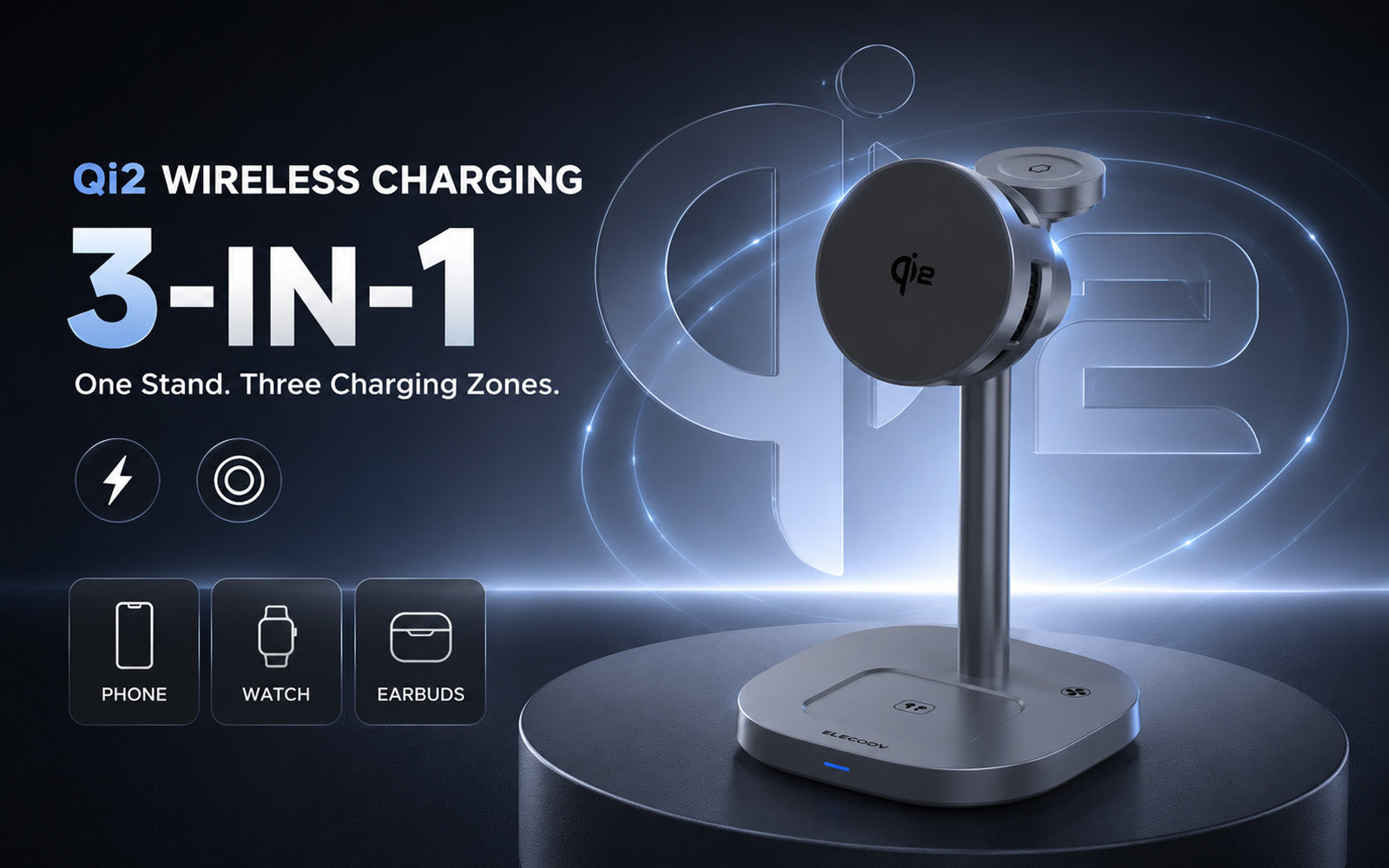
Elecdov Qi2 3-in-1 wireless charging stand product showcase with glowing blue background
Qi2 25W: three certified charging zones negotiated from a single upstream supply.

This is where the 25W profile changes the calculation. The WPC specifies that Qi2 25W takes a fully depleted smartphone to approximately 50% in about 30 minutes — nearly 70% more charging power than the original Qi2 profile. A lounge stop is no longer a marginal top-up. It is a half-battery recovery.

Travel interval Typical duration Qi2 15W recovery Qi2 25W recovery
Gate wait 25 min ~20–25% ~40–45%
Lounge stop 45 min ~35–40% ~65–70%
Short-haul rail leg 90 min ~65–75% Full charge with headroom
Hotel evening 6–8 h Full, all devices Full, all devices

Recovery figures are indicative for a modern flagship-class battery from a low state of charge; actual results vary with cell size, ambient temperature and background load.

The cabin is becoming a transmitter

The longer-term shift is that the aircraft itself is being fitted with the transmitter side. In April 2026 a Wireless Power Consortium member announced a Qi2 wireless charging module designed for modern aircraft cabins, delivering wireless charging to passengers and crew at seat level. Retrofit across global fleets is a multi-year programme, but the direction is unambiguous, and it is reinforced by scale: Boeing's 2026 Commercial Market Outlook, published ahead of the Farnborough show in July 2026, projects air travel demand roughly doubling over the next twenty years and the global fleet growing nearly 80% to more than 50,000 aircraft by 2045.

“Qi2 25W can wirelessly charge a fully depleted smartphone battery to 50% charge in about 30 minutes.”

— Wireless Power Consortium, Qi2 25W standard announcement

Chapter Q&A

Q: Will an aircraft seat module charge my phone at 25W?
A: Output depends on the module specification and the aircraft's available seat power budget, which is typically conservative. Treat in-seat wireless charging as trickle-to-moderate maintenance charging, and continue to do the substantive recovery on the ground.
Q: Does magnetic alignment matter more when travelling?
A: Considerably. On a moving train, in a taxi or on a tray table, a flat non-magnetic pad loses alignment with every movement and silently stops charging. The magnetic ring in Qi2 keeps the coils registered through motion, which is the difference between arriving charged and arriving flat.
04
Multi-Modal

Rail, Road and the Segments Between Airports

Business travel is rarely a single flight. It is a chain: taxi, terminal, aircraft, rail transfer, hire car, hotel. Each segment has a different power environment, and the rail and road segments are where a charging kit is most often defeated.

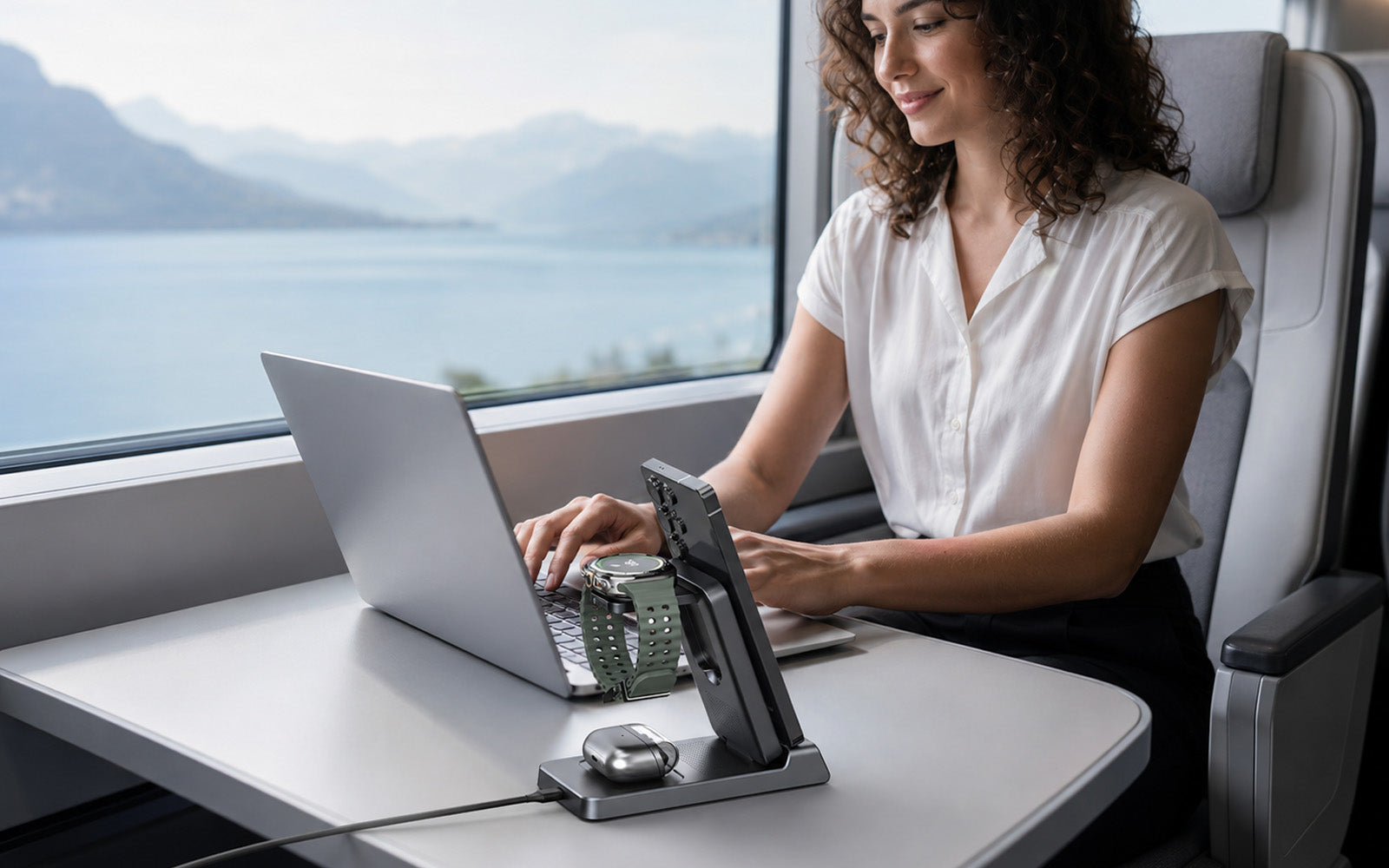
Woman working on laptop on high-speed train with Elecdov 3-in-1 wireless charging station and scenic window view
The rail leg: a socket may exist, but a flat pad on a moving table does not hold alignment.

Rail

High-speed rail is the most favourable environment in the chain: seat sockets are common, dwell time is long, and there are no lithium-battery use restrictions comparable to aviation. The failure mode here is mechanical, not regulatory — vibration and table movement dislodge devices from flat pads. A magnetic stand that grips the handset and holds a viewing angle converts a rail leg into genuine working time with a full recharge.

Road

Vehicle segments impose the opposite constraint: short duration, high vibration, and a phone that must remain visible for navigation. Magnetic retention is not a convenience here, it is a safety requirement. The device has to stay put through cornering and braking while remaining glanceable.

Terminal transfers

Transfer windows are the most underused charging opportunity in the chain. A traveller with a folding stand in an outer laptop-sleeve pocket can deploy at any seating area in under ten seconds. A traveller whose charger is buried at the bottom of a case will not bother for a 20-minute window — and will board with 30% battery.

✈ Case Study: A Four-Segment Business Itinerary Without a Power Bank

Itinerary. Home → airport rail (45 min) → long-haul flight (11 h) → airport → hotel. Devices: phone, smartwatch, wireless earbuds, laptop.

Kit. One folding Qi2 25W 3-in-1 stand (0.25 in closed, 11.43 oz), one 65W PD supply, one USB-C cable. No power bank carried.

Execution:

  • Rail leg: stand deployed at the seat socket; phone recovered from 40% to full, watch and earbuds topped up in parallel.
  • Lounge, 50 min: laptop on the PD supply, phone held at full on the stand.
  • In flight: no power bank use required — therefore no exposure to the carrier's restriction; devices used in low-power mode from a full start.
  • Arrival: phone at 46% after 11 hours. Hotel desk restored all four devices from a single wall socket.

Read-through. Removing the power bank removed a compliance risk and roughly 12 oz of carried weight, without producing a battery shortfall. The condition for that outcome is disciplined use of ground dwell time, which the 25W profile makes viable.

Chapter Q&A

Q: What if the rail seat socket is occupied or broken?
A: This is the residual case for a small sub-100Wh power bank. Keep it in carry-on, keep it unused in the cabin, and treat it as contingency rather than as the primary plan.
Q: Is a magnetic car mount necessary if I already have a stand?
A: They solve different problems. A desk or table stand is not designed for vibration and cornering loads. For any meaningful driving segment, a dedicated magnetic car mount is the correct hardware for both retention and safety.
05
Destination

The Hotel Room as a Temporary Workstation

The final segment is the one that determines whether the next day starts well. A hotel room is a workstation you occupy for one to three nights, with an unknown socket layout, frequently a single accessible outlet at the desk, and no tolerance for a setup ritual after a long travel day.

Professional indoor working environment with laptop, documents and Elecdov 3-in-1 wireless charging station
The hotel desk: one socket, four devices, and no appetite for a twenty-minute cable ritual.

Three requirements

  • Single-socket operation. The kit must run phone, watch and earbuds from one outlet, because that is frequently all that is reachable from the desk or the bedside.
  • Sub-30-second deployment. Unfold, connect one cable, place three devices. Anything more elaborate will be skipped on the third night.
  • Departure-proof. A magnetic stand with no loose small parts is difficult to leave behind. Individual watch cables are the most commonly abandoned item in hotel rooms.

Practically, a folding 3-in-1 stand plus a single PD supply covers the phone, watch and earbuds, and the same supply serves the laptop overnight once the phone is topped up. The whole assembly occupies less bag volume than the four cables it replaces.

Elecdov Engineer's Note

Packing discipline matters more than specification. Store the folding stand in an outer laptop-sleeve pocket, never in a main compartment. The single strongest predictor of whether a traveller arrives charged is not the stand's rated wattage — it is whether the stand is reachable in under ten seconds at a gate seat. A 25W unit at the bottom of a case delivers 0W.

Also worth noting: at 40°C certified surface ceiling, a compliant Qi2.2 unit is safe on a bedside surface overnight. That is a specification consequence, not a manufacturer assurance.

1Wall socket required
3Devices served simultaneously
0.25 inFolded stand thickness
11.43 ozCarried weight

Chapter Q&A

Q: Should I bring a travel adapter for the wireless stand or the PD supply?
A: For the PD supply. The stand connects to the supply over USB-C and is voltage-agnostic downstream. One quality universal adapter plus one PD brick serves the entire kit.
Q: Is it safe to leave a wireless charger running overnight in a hotel?
A: For a certified unit, yes. Qi2.2 certification requires the surface temperature to stay below 40°C under sustained 25W, and Foreign Object Detection halts transfer if a metallic object is introduced. Uncertified units carry no such validated guarantee.
06
Conclusion

Conclusion & Recommended Elecdov Travel Kit

The 2026 travel charging position can be stated in one sentence: the device class that airlines are restricting is the one most travellers still depend on, and the device class that carries no restriction has just become fast enough to replace it.

A compliant kit is therefore built around three components — a certified Qi2 folding stand, a single PD supply with genuine headroom, and disciplined use of ground dwell time. A sub-100Wh power bank remains reasonable as contingency for socket-free segments, carried in the cabin and left unused in flight. The configurations below are ordered from full travel capability to minimum carry.

Recommended Elecdov Travel Configurations

Travel Pick · Qi2 25W

Elecdov W103S 3-in-1 Magnetic Charging Station, Qi2 Certified

  • Phone 25W max, Watch 2.5W, Earbuds 5W
  • Folds to 2.76 × 0.25 × 5.20 in, 11.43 oz
  • Input 15V⊛3A / 20V⊛2.25–3.25A
  • FCC, CE, RoHS, QI2 certified
View Product →
Qi2 Certified · Hotel Desk

Elecdov W98S 3-in-1 Magnetic Charging Station for Samsung, Qi2 Certified

  • Phone 5W / 7.5W / 10W max, Watch 2.5W, Earbuds 5W
  • Vertical tower 4.09 × 4.09 × 6.26 in
  • Input USB-C 9V/4A, 12V/3A
  • FCC, CE, RoHS, QI2 certified
View Product →
Value 3-in-1

Elecdov CE20S 3-in-1 Magnetic Charging Station for Samsung

  • Phone 15W, Watch 2.5W, Earbuds 5W
  • USB-A + USB-C passthrough, 15W max
  • 6.89 × 6.10 × 1.97 in, 12.70 oz
  • FCC, UL certified
View Product →
Minimum Carry

Elecdov WC01A 2-in-1 Magnetic Charging Station for iPhone

  • Watch and phone charging in one compact dock
  • Input 5V/2A 10W, output 5V/1A 5W max
  • 3.78 × 3.34 × 3.64 in, 5.11 oz
  • Integrated phone stand and key tray
View Product →

“The best travel charger is not the one with the largest capacity. It is the one that is compliant at the gate and reachable in ten seconds.”

— Elecdov Engineering Desk

Before every departure: verify the operating carrier's current power bank policy, confirm any battery is under 100Wh and in carry-on, and pack the folding stand where it can be reached without opening the main compartment.

Chapter Q&A

Q: Which configuration suits a frequent flyer best?
A: The W103S. It is the only unit here certified for the full 25W profile and it folds to roughly a quarter of an inch, which is what determines whether it is actually carried and deployed during short dwell windows.
Q: Can I use one kit across iPhone and Samsung devices?
A: For the phone coil, yes — Qi2's magnetic profile is cross-brand. The watch zone is the constraint: Apple Watch, Galaxy Watch and Pixel Watch each use proprietary interfaces, so match the station to the watch ecosystem you actually carry.

📌 Article Summary / 文章总结

The restriction is on use, not carriage: Carriers including Singapore Airlines (from 1 April 2025), Malaysia Airlines and Cathay Pacific prohibit operating or recharging power banks in flight; 100–160Wh units also need prior approval, so build the kit around a charger with no internal cell.

Qi2 25W matches the shape of travel time: About 50% charge in roughly 30 minutes turns a gate wait or lounge stop into a real recovery window — and magnetic alignment is what keeps the charge running on a moving train or tray table.

Pack for reachability, not for capacity: A folding stand at ~0.25 in closed and 11.43 oz, plus one PD supply, serves phone, watch and earbuds from a single hotel socket — and a charger you can deploy in ten seconds outperforms a higher-rated one buried in a case.

💡 Ready to upgrade your charging setup? Explore Elecdov's certified Qi2 solutions today.

🔗 Shop Now — View Elecdov Products →
ED

Elecdov Engineering Desk

Wireless Power Systems & Compliance Team

Elecdov's engineering team designs and validates Qi2 certified magnetic charging systems for mobile and travel use. Regulatory references in this article reflect published carrier advisories and WPC specification data; travellers should confirm current policy with the operating carrier before departure.

Travel Light. Arrive Charged. Stay Compliant.

Elecdov's Qi2 certified folding stations deliver 25W-class magnetic charging with no internal battery cell — outside the lithium-battery restrictions, inside your laptop sleeve.

Explore Elecdov Qi2 Solutions →

ブログに戻る

コメントを残す

コメントは公開前に承認される必要があることにご注意ください。