Qi2.2 at 637 Certified Products: A 25W Ecosystem Audit on the Eve of Made by Google 2026
共有
Executive Summary
- Qi2.2 certified products reached 637 by the end of February 2026, up from 69 in August 2025 — roughly nine-fold growth in seven months, with January 2026 contributing the largest single-month addition to date.
- The binding constraint is thermal, not electrical. Qi2.2 requires module surface temperature below 40°C at 25W rated output; that clause is why certified supply grew far more slowly than unverified 25W marketing claims.
- Ecosystem scale is now substantial: total Qi2-certified listings reached 2,665 by 31 December 2025, WPC membership stood at 328 companies in January 2026 with over 91% focused on Qi, and certified Qi2.2 power banks reached 64 by the end of December 2025.
- Category maturity is visible in the hard cases. Certified products now exist in the least thermally forgiving segments — sealed power banks and in-car mounts — not just open-air desk stations.
- Buying framework: shortlist on certification class, then charging-zone count, then input rating. Those three criteria eliminate most candidates and represent the most expensive mistakes to reverse.
1. 637 Certified Products: Reading the Curve, Not the Headline
Six hundred and thirty-seven. That is the number of products carrying Qi2.2 certification as of the end of February 2026, and it is the single most useful data point available to anyone trying to decide whether 25W magnetic wireless charging has genuinely arrived or is still an early-adopter proposition.
The number alone is not the story. The shape of the curve is. Certification opened in July 2025. By August 2025 there were 69 listings. By the end of October, 203. By December, 342. By January 2026, 521. By the end of February, 637. That is roughly a nine-fold expansion in seven months, and critically, the monthly additions accelerated rather than plateaued through the winter — January 2026 alone contributed the largest single-month increase in the programme’s history.
Why the curve accelerated when it did
Three forces converged. First, silicon availability: certified Qi2.2 transmitter modules crossed twenty distinct designs by May 2026, which removed the reference-design bottleneck for accessory brands. Second, anchor devices: iPhone 16 and 17 class hardware plus the Google Pixel 10 Pro XL gave the 25W tier real receivers to charge, and a standard without receivers does not attract transmitters. Third, category spread: the profile stopped being a desk-charger story. Qi2.2-certified power banks alone reached 64 products by the end of December 2025, up from 37 in November.
| Checkpoint | Qi2.2 certified products | Interpretation |
|---|---|---|
| August 2025 | 69 | Programme opening — early movers and reference designs only |
| End of October 2025 | 203 | First inflection; accessory brands commit |
| December 2025 | 342 | Category spread begins — power banks, modules, car chargers |
| January 2026 | 521 | Largest single-month addition to date; 500 barrier crossed |
| End of February 2026 | 637 | Ecosystem transitions from early adoption to mainstream availability |
🔧 Elecdov Engineer’s Note — What 637 does and does not tell you
The figure counts certified listings, not shipped units and not distinct product families — colour and regional variants can appear separately. Read it as a supply-side confidence indicator: 637 listings means hundreds of engineering teams committed to passing a thermal test they could have avoided by shipping an uncertified 25W claim instead. That is the meaningful signal.
Q&A — Quick Answers
Q: Is 637 a large number for a charging standard?
A: In context, yes. The total Qi2-certified population — covering the entire magnetic profile including 15W products — stood at 2,665 at the end of December 2025. Qi2.2 reaching 637 within roughly seven months of programme opening represents unusually fast adoption for a standard with an added thermal requirement.
Q: When did Qi2.2 certification actually open?
A: The Wireless Power Consortium published the Qi2.2 profile in December 2024 and opened certification in July 2025. The first certificate issued went to a magnetic charging product from UGREEN.
Q: Does a higher certification count mean prices fall?
A: Historically, broader certified supply correlates with a wider price band rather than a uniform price drop. What buyers gain first is choice across form factors — desk stations, foldable travel stands, power banks and automotive mounts — rather than an immediate discount.
2. Inside the Certification Pipeline: The 40°C Clause That Filters the Market
The reason 637 is a meaningful number and “thousands of 25W chargers on marketplaces” is not comes down to a single sentence in the Qi2.2 specification: at 25W output, module surface temperature must remain below 40°C. No previous Qi revision imposed a comparable constraint at the profile’s rated ceiling.
That clause converts a marketing number into an engineering commitment. Delivering 25W into a phone is a solved problem; delivering it while dissipating the associated losses without exceeding a hand-warm surface is not. It forces decisions in coil geometry, ferrite selection, power-stage efficiency, enclosure material and, in higher-output designs, active airflow.
The five gates a product must clear
| Test gate | Requirement | Typical failure cause | Consumer-visible symptom |
|---|---|---|---|
| Thermal ceiling | Surface below 40°C at 25W rated output | Insufficient dissipation path, sealed plastic enclosure | Hot device, mid-charge throttling, slow overnight recovery |
| Magnetic profile (MPP) | Correct polarity, holding force and coil concentricity | Under-specified magnet array to save cost | Phone slides, drops to trickle charge without warning |
| Power negotiation | Clean handshake across the full envelope | Incomplete protocol implementation | Advertised 25W negotiates down to 7.5W in practice |
| Foreign object detection | Reliable detection and shutdown | Coarse detection thresholds | Coins, keys or card foil heating in the field |
| Interoperability | Verified behaviour across multiple manufacturers | Tuned to one popular handset only | Works with one phone in the household, fails with another |
🏭 Case Study — Why two identical-looking 25W stands behave differently
Setup: Two 3-in-1 stands, both advertising 25W on the phone position, both similar in size and price bracket. One carries Qi2 certification; one does not.
Observed pattern in sustained use: Both reach comparable peak rates in the first several minutes. Divergence appears afterwards. The uncertified unit’s surface climbs past the hand-warm threshold, the receiver requests a lower rate, and the effective average across a ninety-minute session falls substantially below the advertised figure. The certified unit holds a flatter thermal curve and therefore a flatter power curve.
Root cause: Not the power stage — the dissipation path. Certified designs must budget for heat at the specification stage; uncertified designs can defer it to the user.
Buying conclusion: Compare sustained behaviour, and use the certification mark as the proxy when you cannot bench-test yourself. Elecdov’s Qi2-certified W103S, W98A and W98S lines are specified against that sustained profile rather than a peak headline.
Q&A — Quick Answers
Q: What is the single most important difference between Qi2 and Qi2.2?
A: The power ceiling rose from 15W to 25W, but the more consequential change is the thermal requirement: surface temperature must stay below 40°C at rated 25W output. That constraint is what makes the certification a meaningful filter.
Q: How can I tell whether a product is genuinely certified?
A: Look for the Qi mark and verify the listing in the consortium certification database. The WPC states plainly that phrases such as Qi compatible, Qi compliant or works with Qi indicate a product that has not passed certification testing.
Q: Does active cooling automatically mean better charging?
A: Not automatically, but it expands the design envelope. Active airflow gives a designer more thermal budget to hold rated output for longer. What matters is whether the finished product passed the sustained thermal test, not whether it contains a fan.
3. Where the 637 Actually Land: Category Structure of the 25W Ecosystem
A certification count is only actionable if you know which shelf the products sit on. The Qi2.2 population is no longer concentrated in one form factor. It has spread across at least five distinct categories, each with its own buying logic.
The most instructive sub-segment is portable power. Qi2.2-certified power banks numbered 37 in November 2025 and 64 by the end of December 2025 — a near-doubling inside two months. That matters because power banks are the hardest thermal case in the category: a sealed lithium pack delivering 25W wirelessly has almost no dissipation path. Certified products existing in that segment at all is a strong indicator of standard maturity.
| Category | Adoption status | Primary buying criterion | Representative Elecdov configuration |
|---|---|---|---|
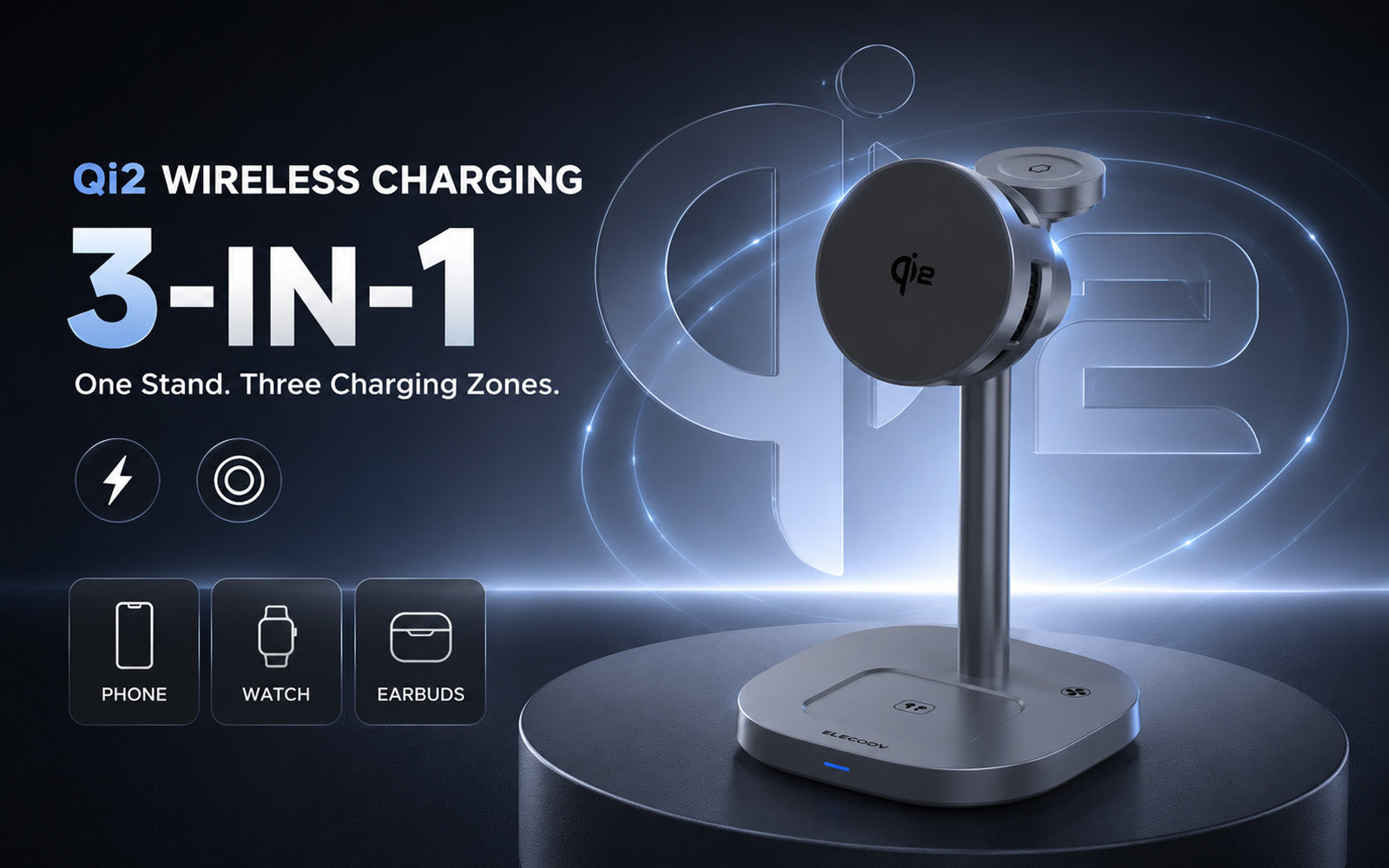
| Desk 3-in-1 stations | Mainstream | Number of independent zones and sustained thermal behaviour | W98A / W98S vertical tower with active cooling |
| Foldable travel stands | Fast growing | Folded thickness, hinge rigidity, magnetic holding force | W103S, 0.25 in folded, 25W certified head |
| Magnetic power banks | 64 certified by end of December 2025 | Sustained output under thermal load, not peak rating | Refer to the Elecdov portable magnetic range |
| Transmitter modules | 23 certified designs by May 2026 | Reference-design availability for OEM integration | Applies to OEM and bulk-order programmes |
| Automotive magnetic mounts | Expanding | Vibration retention plus thermal protection in a hot cabin | Refer to the Elecdov automotive magnetic range |
🔧 Elecdov Engineer’s Note — The professional desk is the easiest win
Of the five categories, the desk station is where certified 25W hardware delivers the most reliable day-to-day benefit, for a simple reason: an open desk has ambient airflow and a stable surface, so a well-designed station operates far from its thermal limit and holds rated output for the entire session.
The design rule we apply is one zone per device, permanently assigned. Three permanently assigned zones eliminate the daily re-plug entirely, and it is the elimination of the re-plug — not the extra 10W — that users report as the actual behaviour change.
What a mature category looks like from the buyer’s side
Maturity is visible in three signals: multiple form factors certified rather than one; a price band rather than a single price point; and certified availability in the hard thermal cases such as power banks and in-car mounts. As of the end of February 2026, all three signals are present.
Q&A — Quick Answers
Q: Which Qi2.2 category should a first-time buyer start with?
A: A desk 3-in-1 station. It offers the best combination of ambient cooling, stable positioning and multi-device coverage, and it is the category where certified hardware most reliably sustains rated output.
Q: Are Qi2.2 power banks worth the premium over standard magnetic packs?
A: They are, if you need sustained output rather than a brief peak. Sealed packs have the least thermal headroom in the category, so certification carries proportionally more information there than anywhere else.
Q: Why do certified transmitter module counts matter to consumers?
A: Modules are the upstream supply. Twenty-three certified module designs by May 2026 means accessory brands can build compliant products without designing power electronics from scratch, which is the mechanism driving the finished-product count upward.
4. The Travel Test: Where the 25W Ecosystem Meets Real Constraints
Standards prove themselves under constraint, and travel supplies more constraint than any other environment: shared sockets, ambient heat, limited time windows, tightening airline rules on lithium power banks, and no bench equipment to diagnose a charge session that quietly failed.
This is where the 40°C clause stops being a specification detail and becomes a user-visible outcome. An airport terminal in summer can sit well above a controlled office ambient. A charger designed with no thermal margin at 23°C will throttle at 32°C. A certified design carries margin by construction.
| Travel constraint | Consequence for uncertified hardware | Certified-hardware behaviour | Recommended action |
|---|---|---|---|
| High ambient temperature | Early throttling, long recovery times | Retains margin against the 40°C ceiling | Buy certified; do not buy on peak wattage |
| Single shared socket | Sequential charging, devices forgotten | Multi-zone parallel delivery from one supply | Carry one 3-in-1 station, not three chargers |
| Cabin lithium restrictions | Capacity you cannot use or must declare | Reduces dependence on carried battery capacity | Prioritise wall-fed magnetic stations |
| Unstable surfaces in transit | Silent charge failure when the phone drifts | Magnetic retention holds alignment mechanically | Use a magnetic head, never a flat pad, in motion |
✈ Case Study — Auditing a travel kit against the standard
Starting kit: One uncertified 25W-claimed folding pad, one proprietary watch cable, one high-capacity power bank of uncertain certification status, and three cables.
Audit findings: The pad’s 25W is a peak figure with no sustained data. The watch cable is a single point of failure with no substitute available in transit. The power bank’s wireless output is unverified and its capacity may require declaration on some carriers.
Revised kit: One Qi2-certified foldable 3-in-1 station serving all three device classes from a single wall socket, plus one short USB-C cable as a wired fallback. Item count falls from six to two; failure modes fall from four to one; and every wireless claim in the kit is backed by a laboratory test rather than a product listing.
Q&A — Quick Answers
Q: Does high ambient temperature really change wireless charging speed?
A: Materially, yes. Charging generates heat, and the receiver reduces requested power as temperature rises. Starting from a hotter ambient means reaching the throttle threshold sooner, which is exactly the failure mode certification is designed to bound.
Q: Should I replace my travel power bank with a wall-fed station?
A: Where sockets are reliably available, a certified wall-fed multi-zone station is the more robust choice and reduces the lithium capacity you carry and declare. Retain a power bank for genuinely off-grid segments.
Q: How many chargers should a three-device traveller carry?
A: One, provided it has three independent zones. The objective is to eliminate zone contention and sequential charging, both of which waste the limited time windows travel provides.
5. The Buyer’s Decision Framework for the Post-637 Market
With 637 certified products in the market, the buyer’s problem has inverted. Twelve months ago the question was whether a compliant 25W product existed at all. Today the question is how to select among hundreds — and abundance without a framework produces worse decisions than scarcity did.
The framework below is the one Elecdov’s engineering desk applies internally. It ranks criteria by how expensive the mistake is to reverse.
| Priority | Criterion | What to verify | Cost of getting it wrong |
|---|---|---|---|
| 1 | Certification class | Qi2 versus Qi2.2 stated explicitly; listing verifiable | Highest — the entire performance claim becomes unverifiable |
| 2 | Zone count | One permanently assigned position per device you own | High — forces a full replacement within a year |
| 3 | Input specification | Upstream supply sized for the combined multi-zone load | High — zones silently compete and none reach rated power |
| 4 | Sustained thermal behaviour | Rated output held over a session, not a peak figure | Medium — slow overnight charging, accelerated battery ageing |
| 5 | Form factor and hinge quality | Folded thickness and angle retention under load | Medium — travel units fail mechanically before electrically |
| 6 | Service terms | Warranty length, return window, regional stock | Low individually, high across a fleet or bulk order |
🔧 Elecdov Engineer’s Note — The input-rating shortcut
If you can check only one number beyond the certification mark, check the input rating. A three-zone station claiming 25W on the phone position while also serving a watch and an earbud case needs genuine upstream headroom. The W103S is specified at 15V/3A and 20V/2.25–3.25A input for exactly this reason; the W98A and W98S accept USB-C at 9V/4A and 12V/3A. A three-zone station fed from a 5V/2A supply cannot deliver its stated numbers, whatever the box says.
Applying the framework to a real shortlist
For a single-user desk, criteria 1–3 decide the purchase; a certified three-zone tower with adequate input resolves it. For a traveller, criterion 5 rises to near the top, because a hinge failure ends the product’s life regardless of its electrical performance. For a business deploying across a team, criterion 6 dominates: warranty length, return policy and regional warehouse coverage determine total cost far more than the unit price does.
Q&A — Quick Answers
Q: What is the fastest way to shortlist among hundreds of certified products?
A: Filter on certification class first, then on zone count, then on input rating. Those three criteria remove the large majority of candidates and are the three mistakes that are most expensive to reverse.
Q: Is the most expensive certified charger always the best choice?
A: No. Price correlates with form factor complexity and cooling design more than with charging performance. A certified 15W three-zone deck can serve a 15W-class device better than a poorly specified 25W single-position pad.
Q: What should a business consider when ordering charging stations in volume?
A: Beyond certification, evaluate warranty duration, return window and regional warehouse coverage, since those determine support cost across a fleet. Elecdov offers an 18-month warranty, a 30-day no-reason return window, twelve overseas warehouses with 2–5 day delivery in Europe and North America, and customisation or bulk-order pricing on request.
📌 Article Summary / 文章总结
✅ The curve matters more than the number: Qi2.2 moved from 69 certified products in August 2025 to 637 by the end of February 2026, with January 2026 delivering the largest single-month addition — acceleration, not a plateau.
✅ The 40°C clause is the real barrier to entry: Qi2.2 requires module surface temperature below 40°C at 25W rated output. That is why certified supply grew far more slowly than 25W marketing claims, and why the mark is a genuine buying filter.
✅ Shortlist on certification, zones and input rating: Those three criteria are the most expensive mistakes to reverse. A three-zone station fed by an undersized supply cannot deliver its stated numbers regardless of the figure on the box.
💡 Ready to upgrade your charging setup with verified Qi2 hardware? Explore Elecdov’s certified Qi2 solutions today.
🔗 Shop Now — View Elecdov Products →📌 结论:637 款认证背后的选购逻辑
Qi2.2 自 2025 年 7 月开放认证以来,认证产品数由 69 款(2025 年 8 月)增至 637 款(2026 年 2 月底),其中 2026 年 1 月单月增量为该计划历史最高;同期 Qi2 认证总量在 2025 年 12 月 31 日达到 2,665 款,WPC 会员达 328 家且超过 91% 聚焦 Qi 生态。真正决定这条曲线斜率的并非 25W 峰值本身,而是 Qi2.2 对 25W 输出下模块表面温度低于 40°C 的强制约束——它把营销数字转化为可验证的工程承诺。
因此 Elecdov 建议以认证等级、充电位数量与输入规格三项为筛选主轴,构建可持续的 Qi2 Ecosystem,让每一次充电都进入 Charge Calm 的稳定区间,而非追逐包装上的峰值瓦数。
📋 要点总结 / Key Takeaways
| 决策点 / Decision Point | 正确规格 / Right Spec | 避免的常见错误 / Common Mistakes |
|---|---|---|
| 认证等级判定 | 明确标注 Qi2 或 Qi2.2,并可在认证名录中核验 | 将 “Qi compatible / Qi 兼容” 等表述误认为已通过认证 |
| 充电位数量规划 | 按持有设备数配置独立分区(手机 / 手表 / 耳机仓各一位) | 多设备共用单一充电面,形成位数争抢与夜间掉充 |
| 输入功率匹配 | 三区站需具备足够上游供电(如 15V/3A、20V/2.25–3.25A 或 USB-C 9V/4A、12V/3A) | 用 5V/2A 适配器驱动三区站,导致各区均无法达到标称功率 |
| 持续输出与热表现 | 关注整段充电周期的持续功率与表面温度,而非前几分钟峰值 | 仅比较峰值瓦数,忽略持续输出下的降频与电池热老化 |
🚚 Recommended Elecdov Qi2-Certified Hardware
Elecdov W103S 3-in-1 Magnetic Charging Station, Qi2 Certified
Qi2 certified 25W magnetic head; foldable travel form factor; Galaxy Z Fold7 / Flip7, Galaxy S & Note series, Galaxy Watch 8 / Ultra / 7 / 6 / 5 / 4 / 3, Galaxy Buds.
Certification: QI2, FCC, CE, ROHS | Size: 2.76 x 0.25 x 5.20 in (folded) | Weight: 11.43 oz
Elecdov W98A 3-in-1 Magnetic Charging Station for iPhone, Qi2 Certified
iPhone 17 / 16 / 15 / 14 / 13 / 12 / 11 / SE and Samsung S25-S22 families; vertical tower with active cooling.
Certification: QI2, CE, FCC, ROHS | Size: 4.09 x 4.09 x 6.26 in | Weight: 19.40 oz
Elecdov W98S 3-in-1 Magnetic Charging Station for Samsung, Qi2 Certified
Galaxy Z Flip7 / Fold7, S26 Ultra / S25 Ultra / S24 Ultra and down; iPhone 16-8; Galaxy Watch 8 / Ultra / 7 / 6 / 5; Galaxy Buds 3 Pro.
Certification: QI2, FCC, CE, ROHS | Size: 4.09 x 4.09 x 6.26 in | Weight: 19.40 oz
Elecdov CE20S 3-in-1 Magnetic Charging Station
Galaxy S26-S20 / Note / Z Flip7-3 / Z Fold6-3, Galaxy Watch 8-3 and Active series; dual-coil deck with digital clock.
Certification: FCC, UL | Size: 6.89 x 6.10 x 1.97 in | Weight: 12.70 oz
🔗 Related Elecdov Reading
- Qi2.2 Hits 637 Certified Products: Why 2026 Is the Year of 25W Magnetic Wireless Charging
- Qi2.2 25W Wireless Charging Market Analysis 2026: 637 Certified Products and the Rise of High-Power Magnetic Alignment
- Qi2.2 25W Crosses 600+ Certified Products: What the 2026 Wireless Charging Shift Means for Buyers
- Qi2 25W One Year On: 1.5 Billion Devices, 13,000 Certified Products, and the Efficiency Rules Next
- Why Android Phones Lag in Qi2 Adoption: Market Analysis & Elecdov Solutions
Elecdov Editorial & Engineering Desk
Elecdov designs Qi2 and Qi2.2-class magnetic charging stations for the Apple, Samsung and Google ecosystems. Our editorial desk tracks Wireless Power Consortium certification listings, OEM launch announcements and thermal test data, then translates them into buying guidance you can act on.
Brand facts: Qi2-certified product lines · 18-month warranty · 30-day no-reason returns · 12 overseas warehouses with 2–5 day delivery across Europe and North America · free shipping on orders over $100 · customisation and bulk-order pricing available.
Charge Calm — Build Your Certified Qi2 Setup
Stop guessing which pad actually delivers rated power. Every Elecdov station is engineered around certified magnetic alignment, thermal headroom and multi-device layout.
Browse All Elecdov Chargers →© 2026 Elecdov. Certification figures cited in this article reflect Wireless Power Consortium listings and published industry tracking data as of the publication date. Unreleased hardware is identified as reported or rumoured and is not presented as confirmed specification.